If you were old enough to comprehend what was unfolding, you are now observing the anniversary of one of the worst days of your life. Perhaps appropriately, I'm spending most of the day working on the update to The CIA's Greatest Hits (which will include a chapter on the CIA's strange relationships with some of the hijackers).
Meanwhile, Arthur Naiman, my editor and publisher on the original edition of CGH, has just written 9/11: The Simple Facts: Why the Official Story Can't Possibly Be True. I'd urge everybody to pick up or download a copy, and check out the online videos and other resources he offers to help with understanding his premise.
Over the past few days, a torrent of verbiage has been posted online (I don't watch any TV, so I've mostly escaped that torrent). Here are some notable highlights:
Glenn Smith's "The Fall to Earth" at FDL is one of the most poignant pieces I've seen. Also in that league is Mona Eltahawy's "I Stayed to Fight," a love letter from a Muslim immigrant to her adopted country. Rounding out the must-reads is the lead op-ed at AntiWar.com, "Who Really Kept Us Safe After 9/11," by Steve Chapman. Word.
AntiWar.com also links up to Robert Jensen's excellent survey "Imperial Delusions: Ignoring the Lessons of 9/11." Along those same lines, Jim Lobe's piece is spot on, and the title tells the tale: "Al-Qaeda’s Project for Ending the American Century Largely Succeeded." Remember, the plan was to get us to overreact, get bogged down in land wars in Asia, alienate Muslims across the planet, and bankrupt our treasury. This wasn't exactly a secret, either.
Arun Gupta offers complementary insights on Alternet, in his "Empire of Chaos," subtitled "The neoconservative ideas that shaped the war on terror have evaporated as the United States is battered by an economic depression that shows no end." Hard to argue with.
Also on AlterNet, economist Joseph Stiglitz's Al-Jazeera article puts some data behind those opinions. Rinku Sen gives us an optimist's take on the anniversary, "The Story I Choose To Tell: We All Belong to Each Other." Adele Stan speaks for the pessimists. And over at Salon, the redoubtable Glenn Greenwald posts about some counterintuitive polling data about 9/11, ten years on.
The HuffPo has a full page of coverage, and there you can find a link to the videos of David Letterman's and Jon Stewart's return to the airwaves. Jesse Kornbluth offers his memories of hosting an online AOL chat room in the hours following the attacks. They also link to an LA Times story about how hard it is to teach about 9/11 to schoolchildren, Believe me, it is. Oh, and Earl Ofari Hutchinson tut-tuts about how sad it is that people still believe in conspiracy theories about 9/11. Yeah, damn shame.
So what's the best thing you've read about 9/11? Any recommendations?
Showing posts with label conspiracies. Show all posts
Sunday, September 11, 2011
Sunday, July 17, 2011
October Surprise Redux
Robert Parry 's reporting continues to make mincemeat out of apologists for Bush the Elder. In a new article he runs down more evidence conveniently overlooked and/or covered up:
In November 1991, as Newsweek and The New Republic were ridiculing the idea that Ronald Reagan's campaign chief William Casey might have made a secret trip to meet Iranians in Madrid in 1980, a senior State Department official was informing George H.W. Bush's White House that Casey indeed had gone to Spain on a mysterious visit...
Casey’s family grudgingly turned over his personal records to congressional investigators, but Casey's 1980 passport was missing along with several pages from his personal calendar for that year... From the Bush library files, there's no indication that the White House told investigators about Williamson's information regarding a Casey trip to Madrid. Nor did anyone in power do anything to stop the Washington press corps' rush to judgment, which condemned Jamshid Hashemi as a liar and a perjurer.It helps to keep these sorts of things in mind, apropos the kind of folks we're dealing with in Washington, and the extent to which they are capable of not just obfuscating, but obliterating, reality.
Thursday, July 14, 2011
Blogging Leftovers
It's always a pleasure to visit my parents, and one of the side benefits is the sheer bulk of the right-wing propaganda my dad has lying around. I do my best to keep in touch with the loyal opposition, but I can really get an immersion in the conservative milieu when I'm there. So, for instance, I got to thumb through Ann Coulter's latest hate literature, Demonic. Therein I learned that righties still can't get over the French Revolution, for one thing.
And a lot of Coulter's schtick consists of "nyah, nyah, you guys do it, too." So I was amused to see her chapter equating the fever dreams of the birthers with the left's "obsession" with the October Surprise. If only. Most lefties, like everyone else, have too many more recent scandals to keep up with. But one reporter who's never let go of the story is Robert Parry. He's long since demolished the tissue of lies that "vindicated" Poppy Bush. And tonight I see that he's used a FOIA request to examine how the tissue of lies was constructed in the first place. Very illuminating reading.
It was also amusing to watch a bit of Fox News, and see Bill O'Reilly and Dick Morris treat each other like serious thinkers. That about made my day. They both seem to think that Obama is really going to take the heat for his intransigence on the debt ceiling talks. Ask Mitch McConnell how that's working out , fellas. Over at the news division I learned that a testy Obama walked out of the talks today, and I had a feeling that there was a bit more to the story than they were letting on. Ya think ?
At a dinner party tonight the topic of the Shaggs came up - well, because I brought them up. For some reason I was reminded that a stage adaptation of their singular story has been unleashed on the world . If you don't know them, this 1999 New Yorker profile is a good intro . If you do know their strangely compelling outsider music, then you want to stop by their official site. I always thought those girls' story would make a great movie, and maybe that's just a matter of time, now. But you still have a chance to say you were into them before they were cool.
The Yglesias blog is always a fecund source of wonkery, but today his intern, Matthew Cameron, delivered some useful thinking on agricultural policy.
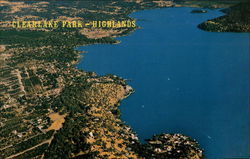
Finally, I never get tired of airplane rides, no matter how old I get. Last week when we flew up to Portland, I got a great view of Clear Lake, CA, which looked something like this.
Yesterday I got to visit the place on a lovely California day and even paddle around a bit on a canoe. Gives you a completely different perspective - kind of like seeing a story on Fox News and then getting a closer look later on.
And a lot of Coulter's schtick consists of "nyah, nyah, you guys do it, too." So I was amused to see her chapter equating the fever dreams of the birthers with the left's "obsession" with the October Surprise. If only. Most lefties, like everyone else, have too many more recent scandals to keep up with. But one reporter who's never let go of the story is Robert Parry. He's long since demolished the tissue of lies that "vindicated" Poppy Bush. And tonight I see that he's used a FOIA request to examine how the tissue of lies was constructed in the first place. Very illuminating reading.
It was also amusing to watch a bit of Fox News, and see Bill O'Reilly and Dick Morris treat each other like serious thinkers. That about made my day. They both seem to think that Obama is really going to take the heat for his intransigence on the debt ceiling talks. Ask Mitch McConnell how that's working out , fellas. Over at the news division I learned that a testy Obama walked out of the talks today, and I had a feeling that there was a bit more to the story than they were letting on. Ya think ?
At a dinner party tonight the topic of the Shaggs came up - well, because I brought them up. For some reason I was reminded that a stage adaptation of their singular story has been unleashed on the world . If you don't know them, this 1999 New Yorker profile is a good intro . If you do know their strangely compelling outsider music, then you want to stop by their official site. I always thought those girls' story would make a great movie, and maybe that's just a matter of time, now. But you still have a chance to say you were into them before they were cool.
The Yglesias blog is always a fecund source of wonkery, but today his intern, Matthew Cameron, delivered some useful thinking on agricultural policy.
Finally, I never get tired of airplane rides, no matter how old I get. Last week when we flew up to Portland, I got a great view of Clear Lake, CA, which looked something like this.
Yesterday I got to visit the place on a lovely California day and even paddle around a bit on a canoe. Gives you a completely different perspective - kind of like seeing a story on Fox News and then getting a closer look later on.
Saturday, May 14, 2011
1999: The Bogus Chinese Spy Scandal
This particular scandal was just one of many that the GOP noise machine has summoned up and amplified through its Faux News and hate radio conduits over the years; by now they have it down to a science.
It's not that I don't think the Chinese were/are spying on us - that's self-evident. But what's interesting is what nobody seemed to suspect at the time: far from mollycoddling the Chinese, Clinton may have actually bombed their embassy on purpose during the Kosovo War.
Okay, plenty of people suspected that, but now we have some informed speculation for the reason. The Serbs had managed to shoot down a Stealth bomber, and the Chinese embassy had parts of the wreckage on hand for analysis. Now that the Chinese have stealth technology of their own, it looks in retrospect like the unusual bombing run that took out their embassy was an unsuccessful attempt to prevent such a development.
A couple issues ago I promised I would say something about the "bogus Chinese spy scandal." It's not that I think the Clinton Administration is incapable of selling off policy to the highest bidder (just like its illustrious predecessors). It's just that our China policy has always been remarkably bipartisan: the purchasing power of 1.2 billion Chinese has always been far more important to us than their human rights.
It's not that I don't think the Chinese were/are spying on us - that's self-evident. But what's interesting is what nobody seemed to suspect at the time: far from mollycoddling the Chinese, Clinton may have actually bombed their embassy on purpose during the Kosovo War.
Okay, plenty of people suspected that, but now we have some informed speculation for the reason. The Serbs had managed to shoot down a Stealth bomber, and the Chinese embassy had parts of the wreckage on hand for analysis. Now that the Chinese have stealth technology of their own, it looks in retrospect like the unusual bombing run that took out their embassy was an unsuccessful attempt to prevent such a development.
A couple issues ago I promised I would say something about the "bogus Chinese spy scandal." It's not that I think the Clinton Administration is incapable of selling off policy to the highest bidder (just like its illustrious predecessors). It's just that our China policy has always been remarkably bipartisan: the purchasing power of 1.2 billion Chinese has always been far more important to us than their human rights.
Saturday, May 7, 2011
Bin Laden in Bosnia
![]() |
| Mujeheddin warriors in the Balkans, circa 1995 |
But this is the same Izetbegović who rejected a peace plan in early 1992. That is, he rejected it, but only after signing it, along with his Serbian and Croatian counterparts. The Carrington-Cutileiro peace plan was negotiated and agreed to by all sides in the conflict before the Bosnian War broke out. And as Indian General Satish Nambiar reflected:
It is ironic that the Dayton Agreement on Bosnia [in 1995] was not fundamentally different from the Lisbon Plan drawn up by Portuguese Foreign Minister Cuteliero and British representative Lord Carrington to which all three sides had agreed before any killings had taken place, or even the Vance-Owen Plan which Karadzic was willing to sign.
Labels:
CIA,
conspiracies,
foreign policy,
Kosovo,
Libya,
military,
politics,
war
Thursday, May 5, 2011
The CIA's Greatest Hits: 6 Bonus Tracks
I just made a deal to put out a new edition of my 1994 book, The CIA's Greatest Hits. Along with fixing any bonehead errors and adding updates to existing chapters (Libya, for one), there will be six chapters of new material, each with a new cartoon. Here's a sneak preview of the Agency's new material - though I know many of you still prefer their early work best....
Kosovo: The 1999 war in Kosovo reflects a familiar pattern with the CIA: alliances with drug-runners, terrorists and gangsters. The lucky ally in this case was the Kosovo Liberation Army (KLA), which succeeded in wresting the territory from Serbia with the help of a 78-day US bombing campaign. What’s interesting is that al-Qaeda may also have been involved – on the same side as the US.
Wednesday, May 4, 2011
Speculators
Marcy Wheeler is like one-woman truth squad, debunking GOP torture apologists' claims that it was really W and Cheney's waterboarding program we have to thank. Cheney himself speculated along those lines: "I would assume the enhanced interrogation program we put in place produced some of the results that led to bin Laden's ultimate capture." [emphasis mine]
Well, that's their story, and they're sticking to it. It's quickly become one of the official GOP talking points in their response to this week's geopolitical earthquake. As Wheeler, AKA Emptywheel, inconveniently points out, though, not only did the waterboarded terrorists not give out the actionable intelligence during their years of torture, they gave out plenty of false leads that led to the US squandering millions of dollars chasing wild geese.
Labels:
CIA,
conspiracies,
foreign policy,
military,
Obama,
war
Tuesday, April 26, 2011
2002: Enron Body Count
I suppose you'd have to add the conveniently timed death of Kenneth Lay to the mysteries surrounding the Enron case. I'm just wondering - do people investigating Obama's birth certificate keep dropping off like this?
As amusing as it is to watch the Usurper from Texas squirm and lie as Buick-sized chunks from the Enron eruption hurtle towards the White House, we must not lose sight of the fact that many of the company's employees and investors have been financially devastated. Plus, at least one of them is quite dead.
Wednesday, April 13, 2011
2005: The Abramoff Scandal
It took a long time, but Tom DeLay, once one of the most powerful men in Washington, is now doing time for his role in this scandal - which, like the Plame scandal is now a major motion picture. Here's how it looked at the time:
Few Americans have ever heard of Jack Abramoff. But then, most Americans can’t tell you who their local Congressmuppet is, either. And most Americans had never heard of Tom DeLay until the day he was indicted.
And it’s not just “average” Americans, either, whoever they are. I have a friend who ran for Congress in 2002. He tried to explain to the editorial board at one of the district’s main newspapers why the incumbent should be denied re-election. His opponent, he said, was a major ally of Tom DeLay. Who, asked these professional journalists, is Tom DeLay?
Few Americans have ever heard of Jack Abramoff. But then, most Americans can’t tell you who their local Congressmuppet is, either. And most Americans had never heard of Tom DeLay until the day he was indicted.
And it’s not just “average” Americans, either, whoever they are. I have a friend who ran for Congress in 2002. He tried to explain to the editorial board at one of the district’s main newspapers why the incumbent should be denied re-election. His opponent, he said, was a major ally of Tom DeLay. Who, asked these professional journalists, is Tom DeLay?
Saturday, April 9, 2011
2005: The Plame Scandal
Just a little reminder about the kinds of folks we're dealing with here...
A criminal conspiracy at the heart of the White House: just like Watergate, that’s what the Traitorgate scandal is all about. At this writing, “Scooter” Libby, Chief of Staff to the Vice-President and a senior assistant to the President, has become the first sitting White House official to be indicted in over 130 years.
The 5-count indictment charges that Libby did “conspire” to obstruct the investigation into the disclosure of a covert agent. Conspiring is not something you can do alone, and Karl Rove (presumably identified as “Official A” in the indictment) is still under investigation. Rove is the most malevolent thug to serve in the executive branch since J. Edgar Hoover. He may or may not end up doing time over his role in this case, but based on what is already known, he has brought everlasting disgrace to this administration.
But that shame goes beyond this shameless White House. It flows–like a spilled wine glass to the carpet–into the roles of both the media and the electorate in enabling these criminals.
Friday, April 8, 2011
1999: The No Conspiracy Blues
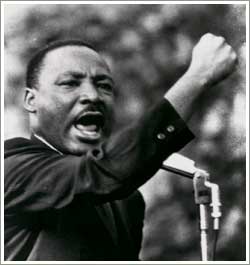
This is the third in a series of three annual April columns about the MLK assassination that ran in the Tucson Comic News in 1997, 1998, and 1999:
To virtually nobody's surprise, the US Department of Justice announced last week that there was no conspiracy in the death of the late Reverend Doctor Martin Luther King Junior, who is honored with a national holiday, even here in Arizona. At least, that was the gist of the story as reported by those news outlets that bothered to cover it at all. A Justice Department spokesman hastened to point out that they didn't find that there was absolutely no conspiracy at all. It’s just that they weren't able to find one after investigating for the last eighteen months.
It turns out that Janet Reno had asked her investigators to look into only two allegations. One, whether a Memphis barman named Lloyd Jowers had been telling the truth when he confessed to being a part of a conspiracy to assassinate King, which included members of tile Mafia and the federal government And two, whether a former FBI man named Donald Wilson had been telling the truth when he claimed to have recovered documents from the car of accused lone nut assassin James Earl Ray, which tended to corroborate Ray’s version of the events.
To virtually nobody's surprise, the US Department of Justice announced last week that there was no conspiracy in the death of the late Reverend Doctor Martin Luther King Junior, who is honored with a national holiday, even here in Arizona. At least, that was the gist of the story as reported by those news outlets that bothered to cover it at all. A Justice Department spokesman hastened to point out that they didn't find that there was absolutely no conspiracy at all. It’s just that they weren't able to find one after investigating for the last eighteen months.
It turns out that Janet Reno had asked her investigators to look into only two allegations. One, whether a Memphis barman named Lloyd Jowers had been telling the truth when he confessed to being a part of a conspiracy to assassinate King, which included members of tile Mafia and the federal government And two, whether a former FBI man named Donald Wilson had been telling the truth when he claimed to have recovered documents from the car of accused lone nut assassin James Earl Ray, which tended to corroborate Ray’s version of the events.
Wednesday, April 6, 2011
1998: James Earl Ray, Again
![]() |
| Dr. King's son Dexter shaking hands with James Earl Ray |
This anniversary is being marked by the same sort of nonsense in the media that we see with the JFK case every five years. Both ABC and CBS presented specials on the King case last month, each following a familiar structure. Maybe you can produce your own bold expose if you follow this formula: First, tell the audience what "some conspiracy theorists" believe. Leave out all of their most convincing evidence; mention only the most incredible claims. Then, take a skeptical look at the Official Story, poking holes in a few weak spots. Finally, break out the big guns and shoot those wacko conspiracy buffs out of the water. Convincingly refute a minor claim or two in their theories. Conclude by speculating darkly that "we may never know the truth."
ABC, for instance, completely forgot to mention that several others have admitted to involvement in the crime, including one Lloyd Jowers, who, like Ray, is nearing the end of his life. He'd be happy to tell what he knows if the case is reopened, but this is something the Memphis DA is loath to do. Using somewhat circular reasoning, he refuses to grant Mr. Ray a trial on the grounds that the case has already been "litigated to death." Oh, really?
Monday, April 4, 2011
1997: James Earl Ray
This is the month our government honors the memory of Dr. Martin Luther King. Unfortunately, it's a hollow honor, since the government has imprisoned an innocent man for Dr. King's murder, while covering up for the guilty parties involved.
Now, it's true that Ray pleaded guilty to the crime in 1969. It's also true that he was kept in a brightly lit cell 24 hours a day, with two armed guards and television cameras watching him until he did so. It's also true that he did so only after his mob-connected attorney told him that he would get the death penalty unless he pleaded guilty, that his father and brother would be jailed unless he pleaded guilty, and most importantly (and falsely), that he could not change his attorney until after he had pleaded guilty.
Ever since that day, James Earl Ray has maintained his innocence, and has worked in vain to be granted a trial. The US government, at least, has not given him one - yet. But in 1993, the cable network HBO did. Ray was given a mock trial with a retired judge, a jury of his peers from Memphis, Tennessee, actual Memphis prosecutors, and his own legal defense team. After hearing from all relevant witnesses, both dead (on tape) and alive, the jury found Ray not guilty of assassinating Dr. King.
Friday, March 11, 2011
2001: The Covert War Against Rock
Speaking of crackpot conspiracy theories, I got a million of them. While it's certainly valid that extraordinary claims require extraordinary evidence, it's also the case that the Official Story from the government is often a most extraordinary claim without a great deal of supporting evidence. Which, of course, requires us to theorize about what really happened.....
From the beginning, rock music has been about rebellion, sexuality and racial intermingling. And right from the beginning, there have been powerful forces utterly freaked out by that agenda. It's the premise of Alex Constantine's book The Covert War Against Rock (Feral House, 2000) that those folks didn't exactly shrink from the occasional use of lethal force.
Doubtless for some of you that thesis is relatively near-fetched. But we do live in a culture where information conglomerates still try to convince us that powerful political figures of the sixties were taken out by a series of Lone Nuts. Corporate media pundits invoke the magic words "conspiracy theory" to settle any argument. But Constantine marshals an impressive range of evidence in chronicling the suspicious circumstances regarding some famous exits. The wordy subtitle reads "What You Don't Know About the Deaths of Jim Morrison, Tupac Shakur, Michael Hutchence, Brian Jones, Jimi Hendrix, Phil Ochs, Bob Marley, Peter Tosh, John Lennon and The Notorious B.I.G."
Covert War starts by looking at the overlapping worlds of government intelligence agencies, organized crime, and virulent right-wing wackos - noting helpfully that each group has had a hand in the music business from time to time. They've worked together in the past to take out common enemies, both foreign and domestic; many such cases are discussed in my own book The CIA's Greatest Hits
(Odonian, 1994). The Agency is particularly adept at terminating inconvenient humans using coroner-baffling methods that mimic natural causes. And if they can apply such skills to politicians (and, erm, journalists), well, hey, what's a rock star or two for good measure?
From the beginning, rock music has been about rebellion, sexuality and racial intermingling. And right from the beginning, there have been powerful forces utterly freaked out by that agenda. It's the premise of Alex Constantine's book The Covert War Against Rock (Feral House, 2000) that those folks didn't exactly shrink from the occasional use of lethal force.
Doubtless for some of you that thesis is relatively near-fetched. But we do live in a culture where information conglomerates still try to convince us that powerful political figures of the sixties were taken out by a series of Lone Nuts. Corporate media pundits invoke the magic words "conspiracy theory" to settle any argument. But Constantine marshals an impressive range of evidence in chronicling the suspicious circumstances regarding some famous exits. The wordy subtitle reads "What You Don't Know About the Deaths of Jim Morrison, Tupac Shakur, Michael Hutchence, Brian Jones, Jimi Hendrix, Phil Ochs, Bob Marley, Peter Tosh, John Lennon and The Notorious B.I.G."
Covert War starts by looking at the overlapping worlds of government intelligence agencies, organized crime, and virulent right-wing wackos - noting helpfully that each group has had a hand in the music business from time to time. They've worked together in the past to take out common enemies, both foreign and domestic; many such cases are discussed in my own book The CIA's Greatest Hits
1995: Dittohead Hate Mail
From the September 1995 Tucson Comic News:
Mark,
I have been a loyal, and paying customer of the Tucson Comic News, for three (3) whole months! I really enjoy the publication. My main reason for writing pertains to the style of your writing. In the first place, are there good and bad power-addicted greedheads? If there are, this is only further proof that you and your lot are completely off kilter.
People view conspiracy theorists like yourself as pot-smokin' crackpots. If you are familiar with political philosophy then you know who Adam Smith was. He wrote the "invisible hand" theory. This stated that rational, free thinking societies would produce that which society needed. Western capitalism as it evolved in the United States has produced more good than bad. The Anasazi wandered around for 20,000 years and got nothing done. We have the greatest society in the world. We did it in 200 years... You seem to take great pride in attacking conservatives. We as Americans shun the thought of a socialist society. You in your rant, set the stage for government domination. Only by the limitation of governmental intrusion can we truly be free. This is the platform of the Republicans. What liberals advocate is the exact opposite. These are the true power-addicted greedheads.
If you think that America is so "corrupt", go over to Russia and tell 'em to clean up Lake Baikal. If you did your Russian would be fluent by the time you got out of corrective labor.
Mark,
I have been a loyal, and paying customer of the Tucson Comic News, for three (3) whole months! I really enjoy the publication. My main reason for writing pertains to the style of your writing. In the first place, are there good and bad power-addicted greedheads? If there are, this is only further proof that you and your lot are completely off kilter.
People view conspiracy theorists like yourself as pot-smokin' crackpots. If you are familiar with political philosophy then you know who Adam Smith was. He wrote the "invisible hand" theory. This stated that rational, free thinking societies would produce that which society needed. Western capitalism as it evolved in the United States has produced more good than bad. The Anasazi wandered around for 20,000 years and got nothing done. We have the greatest society in the world. We did it in 200 years... You seem to take great pride in attacking conservatives. We as Americans shun the thought of a socialist society. You in your rant, set the stage for government domination. Only by the limitation of governmental intrusion can we truly be free. This is the platform of the Republicans. What liberals advocate is the exact opposite. These are the true power-addicted greedheads.
If you think that America is so "corrupt", go over to Russia and tell 'em to clean up Lake Baikal. If you did your Russian would be fluent by the time you got out of corrective labor.
Thursday, March 10, 2011
1991: Pulling Back the Cover-Ups
This book review appeared in the San Jose Metro:
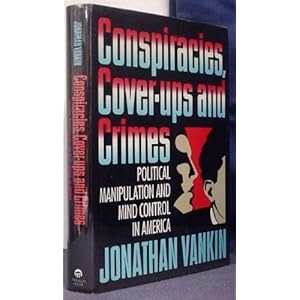
Conspiracies, Cover-ups and Crimes
by Jonathan Vankin
Paragon House, $24.95, 319 pages
I wish every American could read this book, because if even a fraction of it is true, we are in serious trouble. Listen: this is the shit they don’t want you to know. And if you want to know who “they” are, this is the place to look.
Conspiracy theory, writes Jonathan Vankin, is “the last real political heresy.” Drawn to such unauthorized thinking, he spent two years immersed in the topic, and emerged, sanity intact, with the definitive, certainly the most serious, and possibly the only comprehensive look at American conspiracy theory. I cannot reccomend this vital work highly enough (conflict-of-interest check: while Vankin is the News Editor of this publication, I have never met the man. No conspiracy here).
Conspiracies, Cover-ups and Crimes is a triumph, not only of research and interviewing skill, but of condensation. How Vankin managed to fit virtually every notable scandal of the postwar era into such a slender volume is beyond me. While additional detail might have left some treatments slightly less arcane for the lay reader, the book’s briskness is one of its major assets. Scarcely does one grasp the horrible implications of one theory, before Vankin has gallumphed off in another direction, trumpeting yet another heretical interpretation of recent history. This is a quick and easy read, but it synopsizes some of the most crucial and poorly-understood information of our time.
Conspiracies, Cover-ups and Crimes
by Jonathan Vankin
Paragon House, $24.95, 319 pages
I wish every American could read this book, because if even a fraction of it is true, we are in serious trouble. Listen: this is the shit they don’t want you to know. And if you want to know who “they” are, this is the place to look.
Conspiracy theory, writes Jonathan Vankin, is “the last real political heresy.” Drawn to such unauthorized thinking, he spent two years immersed in the topic, and emerged, sanity intact, with the definitive, certainly the most serious, and possibly the only comprehensive look at American conspiracy theory. I cannot reccomend this vital work highly enough (conflict-of-interest check: while Vankin is the News Editor of this publication, I have never met the man. No conspiracy here).
Conspiracies, Cover-ups and Crimes is a triumph, not only of research and interviewing skill, but of condensation. How Vankin managed to fit virtually every notable scandal of the postwar era into such a slender volume is beyond me. While additional detail might have left some treatments slightly less arcane for the lay reader, the book’s briskness is one of its major assets. Scarcely does one grasp the horrible implications of one theory, before Vankin has gallumphed off in another direction, trumpeting yet another heretical interpretation of recent history. This is a quick and easy read, but it synopsizes some of the most crucial and poorly-understood information of our time.
Sunday, February 20, 2011
1991: How This Started
This week marks the twentieth anniversary of the Persian Gulf War, which began February 23, 1991. A typo in the original print version of this article led to an ongoing flame war with a local crank regarding my conspiracy theory outlined below. I eventually offered a bet, to be settled 30 years after the war's anniversary - which means we have just ten years to go. Meanwhile, there are a lot of unanswered questions about the Gulf War - and Saddam may taken answers to some of them to his grave:
The role of the United States in the events leading up to Iraq's invasion of Kuwait should be grounds for deep suspicion. Anyone capable of adding two and two together should keep these four points in mind:
• The London Observer reported October 21st that Iraq's policy of military intimidation of the Kuwaiti royal family to bring about higher oil prices was begun at the behest of the United States. Saddam, at that point the kind of guy we could do business with, was simply repaying a favor - the billions in arms, foodstuffs, and credits we had tossed his way during the '8Os. While higher oil prices might not be the healthiest thing for the US economy, they would certainly be in the interests of George Bush, a major Texaco shareholder.
The role of the United States in the events leading up to Iraq's invasion of Kuwait should be grounds for deep suspicion. Anyone capable of adding two and two together should keep these four points in mind:
• The London Observer reported October 21st that Iraq's policy of military intimidation of the Kuwaiti royal family to bring about higher oil prices was begun at the behest of the United States. Saddam, at that point the kind of guy we could do business with, was simply repaying a favor - the billions in arms, foodstuffs, and credits we had tossed his way during the '8Os. While higher oil prices might not be the healthiest thing for the US economy, they would certainly be in the interests of George Bush, a major Texaco shareholder.
Thursday, January 27, 2011
1994: Conspiracy Theory
You might have noticed that I tend to go on about assassination plots and such. This little rant grew out of my interactions online in the early days of the Web (well, early to me). It appeared in the January, 1994 issue of the Tucson Comic News. Note to scoffers: try googling "Operation Northwoods."
Now, if I had suggested, a couple of generations ago, that the federal government was injecting plutonium into helpless retarded children, just to see what would happen, I would have been called a number of interesting things. Perhaps the nicest of them would have been 'conspiracy theorist.' Actually, I get called that quite a bit in any case....
These days, the words "conspiracy theory" have become a single buzzword, conspiracytheory, which, roughly translated, means, "I don't want to think about that." The pejorative use of the term is used to mean "you are a paranoid wacko." But I use the term proudly, since a lot of what I do is read up on various criminal conspiracies, and try to consider which theories meet the available facts.
After all, the alternative to conspiracy theory is often coincidence theory. For example, if I were to assert, based on a wealth of documented sources, that Lee Harvey Oswald spent an inordinate amount of time hanging out with known CIA agents, extreme rightwingers, wealthy oil industry tycoons, and violently anti-Castro Cuban exiles, there would be two of several ways of looking at these facts. The conspiracy theory would be "perhaps these associations of Oswald's had something to do with the events of November 22, 1963." The coincidence theory would be, "despite these known associates, I believe that Oswald, acting alone, killed JFK." However, only one of these theories is subject to widespread ridicule.
Much of what is put down as conspiracy theory is simply little-known historical fact. The July 1933 plot by fascist US businessmen to stage a coup against FDR, for instance, is simply too well-documented to be refuted. Yet most Americans have never heard of it. Still other conspiracy theorists will take established facts (a significant portion of the money looted during the S&L crisis went to the CIA) and come up with a theory that, while plausible, cannot be proven (the CIA must have planned it that way). There is nothing wrong with theorizing on that basis, as long as the documented facts are identified, and speculation is clearly labeled as such. As long as such guidelines are followed, crying "conspiracy theory!" simply serves to obfuscate the issues involved.
Another buzzword used to trivialize discussions of conspiracy is "revisionist history." This means, of course, "the previous version of history better reflected my belief system." Whether we like it or not, blatant falsehoods pass into history, and if new facts or evidence come to light, history (never a settled, unchallengeable canon of universally accepted facts to begin with) must be revised. Thus the one million "Communists" massacred in 1965 by the Indonesian government become part of revisionist history when interviews with US State Department officials reveal that hit lists were provided to the Indonesian military. Thus the El Mozote massacre in El Salvador, which the Wall Street Journal denounced at the time as, you guessed it, conspiracy theory, now must be redefined as revisionist history. No doubt the Journal would have preferred to have left it unrevised.
Another branch of conspiracy theory, more thoroughly stigmatized, concerns secret societies, which by their very nature invite conspiratorial speculation. Taken to extremes, this leads to Grand Unified Conspiracy Theory, in which the whole of human history is to be explained by the devious machinations of the Freemasons, or the Bavarian Illuminati, or the Jews, or the International Communist Conspiracy, or pick your favorite. This sort of thing gives conspiracy theory a bad name.
But looked at more rationally, secret societies are fertile ground for researchers. There is no denying that certain groups of wealthy and powerful men, meeting in secret, have had considerable influence on the course of history - and continue to do so. A branch of rightwing theory, which has also been embraced by many on the left, concerns the workings of the Council on Foreign Relations, the Trilateral Commission, and, more obscurely, the Bilderberg Group. The fact is that these groups do exist, they do maintain secrecy over some of their activities, and that they wield considerable power and influence. Whether you choose to believe that the Trilateral Commission is, as they claim to be, simply a group of concerned businessmen, or perhaps something more sinister, probably depends on your preconceived notions. Adherents to either view would do well to offer some evidence to back up their claims.
To take a more pedestrian example, consider such institutions as the World Bank or the International Monetary Fund. These very wealthy, mostly white men sit in secret deliberation on how to impose their economic philosophies on Third World countries in exchange for credit, mostly to pay off debts incurred by some bloodthirsty dictator, previously supported by these same men and now, oftentimes, living off deposits kept in their banks. As a direct result of the "austerity" enforced by these agencies, people starve to death.
Is this just "networking," or is this a conspiracy? It certainly meets the dictionary definition (an agreement to perform together an illegal, wrongful or subversive act). It also resonates with the Latin roots (literally, to breathe together). If you want to believe that the Trilateral Commission, who have been breathing together with these institutions since their inception, are engaged in purely innocuous activities, you are certainly free to do so. But I must say, doing so seems to me to require a certain naive faith that our leaders never lie, and that the world is run pretty much the way our newspapers and high-school textbooks say it is.
The best way to look at many conspiracy theories is to consider them as worst-case scenarios. And since much of our history in the postwar era has turned out to be much worse than even the wildest conspiracy theorists dreamed of at the time, it would behoove us to come up with as many conspiracy theories as possible. Now that we're left having to pay compensation to thousands of radiation victims, as well as literally trillions of dollars to clean up the nation's leaking radioactive waste dumps, who is to say what theories are too outlandish to consider? Understanding and theorizing about such conspiracies is not irrelevant or trivial. It is vital to concentrating on the challenges of the future.
Now, if I had suggested, a couple of generations ago, that the federal government was injecting plutonium into helpless retarded children, just to see what would happen, I would have been called a number of interesting things. Perhaps the nicest of them would have been 'conspiracy theorist.' Actually, I get called that quite a bit in any case....
These days, the words "conspiracy theory" have become a single buzzword, conspiracytheory, which, roughly translated, means, "I don't want to think about that." The pejorative use of the term is used to mean "you are a paranoid wacko." But I use the term proudly, since a lot of what I do is read up on various criminal conspiracies, and try to consider which theories meet the available facts.
After all, the alternative to conspiracy theory is often coincidence theory. For example, if I were to assert, based on a wealth of documented sources, that Lee Harvey Oswald spent an inordinate amount of time hanging out with known CIA agents, extreme rightwingers, wealthy oil industry tycoons, and violently anti-Castro Cuban exiles, there would be two of several ways of looking at these facts. The conspiracy theory would be "perhaps these associations of Oswald's had something to do with the events of November 22, 1963." The coincidence theory would be, "despite these known associates, I believe that Oswald, acting alone, killed JFK." However, only one of these theories is subject to widespread ridicule.
Much of what is put down as conspiracy theory is simply little-known historical fact. The July 1933 plot by fascist US businessmen to stage a coup against FDR, for instance, is simply too well-documented to be refuted. Yet most Americans have never heard of it. Still other conspiracy theorists will take established facts (a significant portion of the money looted during the S&L crisis went to the CIA) and come up with a theory that, while plausible, cannot be proven (the CIA must have planned it that way). There is nothing wrong with theorizing on that basis, as long as the documented facts are identified, and speculation is clearly labeled as such. As long as such guidelines are followed, crying "conspiracy theory!" simply serves to obfuscate the issues involved.
Another buzzword used to trivialize discussions of conspiracy is "revisionist history." This means, of course, "the previous version of history better reflected my belief system." Whether we like it or not, blatant falsehoods pass into history, and if new facts or evidence come to light, history (never a settled, unchallengeable canon of universally accepted facts to begin with) must be revised. Thus the one million "Communists" massacred in 1965 by the Indonesian government become part of revisionist history when interviews with US State Department officials reveal that hit lists were provided to the Indonesian military. Thus the El Mozote massacre in El Salvador, which the Wall Street Journal denounced at the time as, you guessed it, conspiracy theory, now must be redefined as revisionist history. No doubt the Journal would have preferred to have left it unrevised.
Another branch of conspiracy theory, more thoroughly stigmatized, concerns secret societies, which by their very nature invite conspiratorial speculation. Taken to extremes, this leads to Grand Unified Conspiracy Theory, in which the whole of human history is to be explained by the devious machinations of the Freemasons, or the Bavarian Illuminati, or the Jews, or the International Communist Conspiracy, or pick your favorite. This sort of thing gives conspiracy theory a bad name.
But looked at more rationally, secret societies are fertile ground for researchers. There is no denying that certain groups of wealthy and powerful men, meeting in secret, have had considerable influence on the course of history - and continue to do so. A branch of rightwing theory, which has also been embraced by many on the left, concerns the workings of the Council on Foreign Relations, the Trilateral Commission, and, more obscurely, the Bilderberg Group. The fact is that these groups do exist, they do maintain secrecy over some of their activities, and that they wield considerable power and influence. Whether you choose to believe that the Trilateral Commission is, as they claim to be, simply a group of concerned businessmen, or perhaps something more sinister, probably depends on your preconceived notions. Adherents to either view would do well to offer some evidence to back up their claims.
To take a more pedestrian example, consider such institutions as the World Bank or the International Monetary Fund. These very wealthy, mostly white men sit in secret deliberation on how to impose their economic philosophies on Third World countries in exchange for credit, mostly to pay off debts incurred by some bloodthirsty dictator, previously supported by these same men and now, oftentimes, living off deposits kept in their banks. As a direct result of the "austerity" enforced by these agencies, people starve to death.
Is this just "networking," or is this a conspiracy? It certainly meets the dictionary definition (an agreement to perform together an illegal, wrongful or subversive act). It also resonates with the Latin roots (literally, to breathe together). If you want to believe that the Trilateral Commission, who have been breathing together with these institutions since their inception, are engaged in purely innocuous activities, you are certainly free to do so. But I must say, doing so seems to me to require a certain naive faith that our leaders never lie, and that the world is run pretty much the way our newspapers and high-school textbooks say it is.
The best way to look at many conspiracy theories is to consider them as worst-case scenarios. And since much of our history in the postwar era has turned out to be much worse than even the wildest conspiracy theorists dreamed of at the time, it would behoove us to come up with as many conspiracy theories as possible. Now that we're left having to pay compensation to thousands of radiation victims, as well as literally trillions of dollars to clean up the nation's leaking radioactive waste dumps, who is to say what theories are too outlandish to consider? Understanding and theorizing about such conspiracies is not irrelevant or trivial. It is vital to concentrating on the challenges of the future.
Sunday, January 23, 2011
1991: Glasnostroika
A lot of my older articles are stored in obsolete file formats (or not at all; a number of them were lost in a hard drive crash, and I'll need to scan them off the paper copies to get them posted here). This one was written directly into Quark XPress (so as to be submitted already laid out for the publisher's page dimensions). Unfortunately, I don't have any software that could open it, 20 years later. But when I googled on "really old Quark files," I stumbled on this guy, who emailed it back to me, good as new. Many thanks, dude! He's a freelance designer and If you need his services, check him out at erikyoungren.com, or email him at erik.youngren@erikyoungren.com. Of course, Mr. Youngren doesn't necessarily endorse anything written on this blog - but then, neither do you.
New York Times columnist William Safire recently displayed uncommon chutzpah, even for him, in calling for free access to the JFK assassination files. The thing is, Safire was talking about the KGB files. Only by coming clean, quoth Safire, about what they know about the JFK hit , could the Russians confront the ugliness of their past (“cesspool of evil” was the phrase, I believe) and move forward. Leaving aside for the moment the question of Mr. Safire’s own ugly past, it’s clear that we could take a few lessons from the erstwhile Soviets on confronting the past.
Our current President likes to crow about how we “won” the Cold War. Like any war, “winning” our 45-year conflict with the Soviets required vast sacrifices of both blood and treasure. The nature of our victory is simply that our opponents went broke before we did. To its credit, however, before folding its hand, the sclerotic Soviet bureaucracy produced a leader of rare vision and courage. Gorbachev not only had the good sense to cut his losses early on, he articulated two fundamental ideals that can guide us through our uncertain future - glasnost and perestroika.
Whether or not our system can produce a leader of comparable vision and courage, this country needs a good hunk of perstroika and a pile of glasnost, at least as much as our old enemies did. It’s time to come clean about the ugliness of our own past - specifically, about the abuses of power, both at home and abroad, that took place during the Cold War period. And it is well past time for a restructuring of the permanent war economy that we have built since the late 1930s.
(For those of you tuning in late, glasnost, loosely translated, means “stop the lies,” while perestroika works out to “stop the thieving.”)
As far as glasnost goes, we have nothing to lose - and everything to gain - by telling the truth about our history. Officially, we still deny having overthrown the governments of Iran and Guatemala in 1953, and dozens of others since then. Indeed, we are sitting on millions of classified documents - some dating as far back as World War I - whose release has heretofore been deemed harmful to our national “security.” Whether the communist threat was our justification or our excuse, that threat is removed.
Whatever our motives, the blood of innocent millions is on our hands, and hiding from the truth will not expunge our guilt. Our leaders - and we the taxpayers - are accountable for the Nazis we embraced to counter the Soviets; for the death squads we trained and equipped; for the drug merchants we did business with. Explanations are due, and apologies. If Japan can apologize to Korea, surely, among our dozens of interventions, from Greece to El Salvador, there are those to whom sincere regrets are long overdue.
Your tax dollars have built an immense national security establishment that fixed elections and overthew legitimate governments all over the world. It’s time to confront how much of that took place at home. We applaud, rightfully, the failure of the coup by Soviet hardliners last August. We need to know the involvement of our own hardliners in prematurely ending the administrations of presidents Kennedy, Nixon and Carter.
The available public record contains abundant evidence that President Kennedy was killed as a result of a conspiracy and that your government knew and lied about this. And as Oliver Stone’s JFK points out, only the US government - or agents thereof - could have weakened the president’s security detail, illegaly removed his corpse from Texas jurisdiction (at gunpoint!), guaranteed a dishonest autopsy under military supervision, and “lost” vital evidence from the National Archives. Before any more evidence is “lost,” we need to lift the 75-year deep freeze ordered by President Johnson.
Mr. Safire’s insinuations to the contrary, the most important details of this episode are not hidden in KGB files. There is no longer any excuse - if any ever existed - to keep secret Lee Harvey Oswald’s tax returns, or those of his associates. Even the most cursory examination of his career shows the influence of our intelligence community. The only question left to be answered is whether he worked for the CIA, the FBI, the Office of Naval Intelligence (ONI) - or all three.
Since the available evidence indicates an inside job, a look at the unavailable evidence is essential. Similarly, we could use a healthy hunk of glasnost regarding two other chapters of our recent history: Watergate and the October Surprise.
As worthy of impeachment as Nixon was, the details of his precipitous fall from power deserve greater scrutiny. The recent book Silent Coup by Colodny and Gittlin builds on earlier work by reporters Jim Hougan (Secret Agenda) and Deborah Davis (Katherine the Great) that shows the ubiquitous footprints of the CIA all over the Watergate “affair.”
Both James McCord, who caused the arrest of his fellow Watergate burglars, and Alexander Butterfield, who revealed the existence of the Oval Office taping system, were career CIA men. Washington Post reporter Bob Woodward, whose reporting constitutes the standard account of the scandal, worked for the ONI. His editor, Ben Bradlee, was CIA, as was the late husband and predecessor of Post publisher Katherine Graham. Deep Throat, Woodward’s anonymous source, was obviously a high intelligence operative. Most ominously, communications went out to US military commanders well before Nixon’s resignation instructing them to disregard any orders from the President.
The reason this is important is that we ought to know why the CIA - the same CIA that covered up for those who removed President Kennedy from office - worked so hard to remove President Nixon. One suspects it was for quite different reasons than the rest of us wanted the bastard removed for. A little glasnost here could be quite illuminating.
Just as important, whatever your feelings about James Earl Carter, is whether the campaign to end his Presidency went beyond politics as usual. As of this writing, the US Congress has not yet funded the committees empowered to investigate the October Surprise - the apparent deal cut by members of the 1980 Reagan-Bush campaign with the government of Iran to prevent the release of 52 American hostages. The salient facts of the matter are these:
Reagan’s own polling data showed that such a release would result in a Carter victory. An “October Surprise Task Force” headed by William Casey and Ed Meese, was formed to prevent such an occurrence. This group was in posession of stolen documents from the White House, provided by at least one “mole.” The Carter Administration had an agreement in place with Iran for a pre-election release of the hostages, involving only spare parts for the Iranian military and a release of frozen Iranian assets in the US. No further military equipment was to be provided. After the the period of October 19-21, when meetings between the Reagan camp and the Iranians allegedly took place, Iran backed off from its agreement with Carter. Once Reagan and Bush had taken office and the hostages were released, vast amounts of military equipment began flowing to Iran within 60 days.
Now, this matter would seem to merit further investigation. It’s true that too much glasnost here might reflect badly on members of the current administration, but, hey, we’ve got to confront the ugliness of our past if we want to move ahead.
As far as moving ahead is concerned, that seems to be happening mighty slow these days. Here too, we can benefit from the example of the late Soviet Empire. Some perestroika could be just what the doctor ordered. Even the president admits our economy is in a “free fall.” The gap between rich and poor has been widening since the early 70s, while real wages have stagnated. And for over half a century, we have propped up our economy with massive military spending. Our victory in the Cold War has left us with a national debt approaching $4 trillion. Meanwhile, our vanquished World War II opponents, Germany and Japan, largely free of the burden of military expenditures, have invested their national treasure in more productive areas.
In 1988, at the height of the Reagan buildup, the Center for Defense Information estimated that we could have provided for our legitimate defense needs - and those of our vital allies - for roughly $100 billion less than we were spending annually. With the disappearance of the Soviet threat, and with our vital allies more than capable of paying for their own defense, our legitimate defense needs are surely a fraction of the Reagan Era budgets. But in his State of the Union message, Bush tells us he wants to cut $50 billion - over five years. By my math, that means $1.45 trillion through 1997, rather than $1.5 trillion.
Obviously, going cold turkey on Pentagon spending is going to cause a lot of pain, just like ending any other addiction. That is why we need a massive national effort - comparable to the moon shot or the Cold War - to find productive work for those dependant on the military gravy train. There is vital work to be done in cleaning up our environment, rebuilding our infrastructure, providing affordable housing, education and health care, and modernizing our transportation network. Spending in any one of these areas will generate more jobs than an equal amount of dollars poured into our military.
We hear a lot these days about the Triumph of Capitalism and the universal need for market-driven economies. Well, you can call our economic system anything you want - just don’t tell me it’s based on the free market. Apart from our annual subsidy to the armaments industry , our fiscal policies and tax codes are providing massive subsidies to the nuclear power industry, the logging companies, the oil companies, automobile companies, agribusiness, pharmaceutical and chemical manufacturers and so on.
Now, intelligent people can argue about whether or not these companies are worthy of subsidy - indeed, we should be arguing about it a lot more than we have been. The common denominator of the industries listed above is that they are all doing serious damage to the environment, which will cost a great deal of treasure to undo, whether we decide to continue subsidizing the damage or not.
The fundamental basis of any American perestroika ought to be the environmental impact of our fiscal policies. If we had spent the last 45 years subsidizing solar power or rail transport, we might not now be arguing about global warming or ozone holes. If we had not fought so hard to keep sucking up more than our share of the world’s resources, we might have learned to live within our means. The benefits of an environment-friendly perestroika could include a reversal of the widening gap between rich and poor, both within our borders and on the planet at large.
As Mikhail Gorbachev pointed out, perestroika and glasnost go hand in hand - you can’t have one without the other. Without an open discussion of our mistakes, of the military and economic policies we have pursued, we will not be able to make informed decisions about restructuring our system along the lines of justice and environmental sanity. And if we don’t have the guts to wrest control of our economy from the old-boys who ahve been lining their pockets for generations on wasteful miltary spending, S&L bailouts, or countless other scams, well, we certainly shouldn’t expect them to tell us the truth
about it.
Oh, and as for William Safire, his ugly past goes beyond his service to the Nixon administration, arguably the biggest cesspool of evil in US history. According to the book Breaking of a President, by Marvin Miller, Safire began his political life as a spokesman for various Mafia front companies. As a wise man once said, before you pull a splinter form your neighbor’s eye, remove the plank from your own.
New York Times columnist William Safire recently displayed uncommon chutzpah, even for him, in calling for free access to the JFK assassination files. The thing is, Safire was talking about the KGB files. Only by coming clean, quoth Safire, about what they know about the JFK hit , could the Russians confront the ugliness of their past (“cesspool of evil” was the phrase, I believe) and move forward. Leaving aside for the moment the question of Mr. Safire’s own ugly past, it’s clear that we could take a few lessons from the erstwhile Soviets on confronting the past.
Our current President likes to crow about how we “won” the Cold War. Like any war, “winning” our 45-year conflict with the Soviets required vast sacrifices of both blood and treasure. The nature of our victory is simply that our opponents went broke before we did. To its credit, however, before folding its hand, the sclerotic Soviet bureaucracy produced a leader of rare vision and courage. Gorbachev not only had the good sense to cut his losses early on, he articulated two fundamental ideals that can guide us through our uncertain future - glasnost and perestroika.
Whether or not our system can produce a leader of comparable vision and courage, this country needs a good hunk of perstroika and a pile of glasnost, at least as much as our old enemies did. It’s time to come clean about the ugliness of our own past - specifically, about the abuses of power, both at home and abroad, that took place during the Cold War period. And it is well past time for a restructuring of the permanent war economy that we have built since the late 1930s.
(For those of you tuning in late, glasnost, loosely translated, means “stop the lies,” while perestroika works out to “stop the thieving.”)
As far as glasnost goes, we have nothing to lose - and everything to gain - by telling the truth about our history. Officially, we still deny having overthrown the governments of Iran and Guatemala in 1953, and dozens of others since then. Indeed, we are sitting on millions of classified documents - some dating as far back as World War I - whose release has heretofore been deemed harmful to our national “security.” Whether the communist threat was our justification or our excuse, that threat is removed.
Whatever our motives, the blood of innocent millions is on our hands, and hiding from the truth will not expunge our guilt. Our leaders - and we the taxpayers - are accountable for the Nazis we embraced to counter the Soviets; for the death squads we trained and equipped; for the drug merchants we did business with. Explanations are due, and apologies. If Japan can apologize to Korea, surely, among our dozens of interventions, from Greece to El Salvador, there are those to whom sincere regrets are long overdue.
Your tax dollars have built an immense national security establishment that fixed elections and overthew legitimate governments all over the world. It’s time to confront how much of that took place at home. We applaud, rightfully, the failure of the coup by Soviet hardliners last August. We need to know the involvement of our own hardliners in prematurely ending the administrations of presidents Kennedy, Nixon and Carter.
The available public record contains abundant evidence that President Kennedy was killed as a result of a conspiracy and that your government knew and lied about this. And as Oliver Stone’s JFK points out, only the US government - or agents thereof - could have weakened the president’s security detail, illegaly removed his corpse from Texas jurisdiction (at gunpoint!), guaranteed a dishonest autopsy under military supervision, and “lost” vital evidence from the National Archives. Before any more evidence is “lost,” we need to lift the 75-year deep freeze ordered by President Johnson.
Mr. Safire’s insinuations to the contrary, the most important details of this episode are not hidden in KGB files. There is no longer any excuse - if any ever existed - to keep secret Lee Harvey Oswald’s tax returns, or those of his associates. Even the most cursory examination of his career shows the influence of our intelligence community. The only question left to be answered is whether he worked for the CIA, the FBI, the Office of Naval Intelligence (ONI) - or all three.
Since the available evidence indicates an inside job, a look at the unavailable evidence is essential. Similarly, we could use a healthy hunk of glasnost regarding two other chapters of our recent history: Watergate and the October Surprise.
As worthy of impeachment as Nixon was, the details of his precipitous fall from power deserve greater scrutiny. The recent book Silent Coup by Colodny and Gittlin builds on earlier work by reporters Jim Hougan (Secret Agenda) and Deborah Davis (Katherine the Great) that shows the ubiquitous footprints of the CIA all over the Watergate “affair.”
Both James McCord, who caused the arrest of his fellow Watergate burglars, and Alexander Butterfield, who revealed the existence of the Oval Office taping system, were career CIA men. Washington Post reporter Bob Woodward, whose reporting constitutes the standard account of the scandal, worked for the ONI. His editor, Ben Bradlee, was CIA, as was the late husband and predecessor of Post publisher Katherine Graham. Deep Throat, Woodward’s anonymous source, was obviously a high intelligence operative. Most ominously, communications went out to US military commanders well before Nixon’s resignation instructing them to disregard any orders from the President.
The reason this is important is that we ought to know why the CIA - the same CIA that covered up for those who removed President Kennedy from office - worked so hard to remove President Nixon. One suspects it was for quite different reasons than the rest of us wanted the bastard removed for. A little glasnost here could be quite illuminating.
Just as important, whatever your feelings about James Earl Carter, is whether the campaign to end his Presidency went beyond politics as usual. As of this writing, the US Congress has not yet funded the committees empowered to investigate the October Surprise - the apparent deal cut by members of the 1980 Reagan-Bush campaign with the government of Iran to prevent the release of 52 American hostages. The salient facts of the matter are these:
Reagan’s own polling data showed that such a release would result in a Carter victory. An “October Surprise Task Force” headed by William Casey and Ed Meese, was formed to prevent such an occurrence. This group was in posession of stolen documents from the White House, provided by at least one “mole.” The Carter Administration had an agreement in place with Iran for a pre-election release of the hostages, involving only spare parts for the Iranian military and a release of frozen Iranian assets in the US. No further military equipment was to be provided. After the the period of October 19-21, when meetings between the Reagan camp and the Iranians allegedly took place, Iran backed off from its agreement with Carter. Once Reagan and Bush had taken office and the hostages were released, vast amounts of military equipment began flowing to Iran within 60 days.
Now, this matter would seem to merit further investigation. It’s true that too much glasnost here might reflect badly on members of the current administration, but, hey, we’ve got to confront the ugliness of our past if we want to move ahead.
As far as moving ahead is concerned, that seems to be happening mighty slow these days. Here too, we can benefit from the example of the late Soviet Empire. Some perestroika could be just what the doctor ordered. Even the president admits our economy is in a “free fall.” The gap between rich and poor has been widening since the early 70s, while real wages have stagnated. And for over half a century, we have propped up our economy with massive military spending. Our victory in the Cold War has left us with a national debt approaching $4 trillion. Meanwhile, our vanquished World War II opponents, Germany and Japan, largely free of the burden of military expenditures, have invested their national treasure in more productive areas.
In 1988, at the height of the Reagan buildup, the Center for Defense Information estimated that we could have provided for our legitimate defense needs - and those of our vital allies - for roughly $100 billion less than we were spending annually. With the disappearance of the Soviet threat, and with our vital allies more than capable of paying for their own defense, our legitimate defense needs are surely a fraction of the Reagan Era budgets. But in his State of the Union message, Bush tells us he wants to cut $50 billion - over five years. By my math, that means $1.45 trillion through 1997, rather than $1.5 trillion.
Obviously, going cold turkey on Pentagon spending is going to cause a lot of pain, just like ending any other addiction. That is why we need a massive national effort - comparable to the moon shot or the Cold War - to find productive work for those dependant on the military gravy train. There is vital work to be done in cleaning up our environment, rebuilding our infrastructure, providing affordable housing, education and health care, and modernizing our transportation network. Spending in any one of these areas will generate more jobs than an equal amount of dollars poured into our military.
We hear a lot these days about the Triumph of Capitalism and the universal need for market-driven economies. Well, you can call our economic system anything you want - just don’t tell me it’s based on the free market. Apart from our annual subsidy to the armaments industry , our fiscal policies and tax codes are providing massive subsidies to the nuclear power industry, the logging companies, the oil companies, automobile companies, agribusiness, pharmaceutical and chemical manufacturers and so on.
Now, intelligent people can argue about whether or not these companies are worthy of subsidy - indeed, we should be arguing about it a lot more than we have been. The common denominator of the industries listed above is that they are all doing serious damage to the environment, which will cost a great deal of treasure to undo, whether we decide to continue subsidizing the damage or not.
The fundamental basis of any American perestroika ought to be the environmental impact of our fiscal policies. If we had spent the last 45 years subsidizing solar power or rail transport, we might not now be arguing about global warming or ozone holes. If we had not fought so hard to keep sucking up more than our share of the world’s resources, we might have learned to live within our means. The benefits of an environment-friendly perestroika could include a reversal of the widening gap between rich and poor, both within our borders and on the planet at large.
As Mikhail Gorbachev pointed out, perestroika and glasnost go hand in hand - you can’t have one without the other. Without an open discussion of our mistakes, of the military and economic policies we have pursued, we will not be able to make informed decisions about restructuring our system along the lines of justice and environmental sanity. And if we don’t have the guts to wrest control of our economy from the old-boys who ahve been lining their pockets for generations on wasteful miltary spending, S&L bailouts, or countless other scams, well, we certainly shouldn’t expect them to tell us the truth
about it.
Oh, and as for William Safire, his ugly past goes beyond his service to the Nixon administration, arguably the biggest cesspool of evil in US history. According to the book Breaking of a President, by Marvin Miller, Safire began his political life as a spokesman for various Mafia front companies. As a wise man once said, before you pull a splinter form your neighbor’s eye, remove the plank from your own.
Sunday, January 9, 2011
2000: Government by Gunplay
This piece about the assassination of Dr. King was commissioned for Xtreme, a British magazine that never quite got off the ground. So technically, it's not really a re-run. As we recall previous political murders in light of recent events, it's worth considering that waiting until all the facts are out may not be an option. Sometimes, all the facts are never out.
To virtually nobody’s surprise, the US Department of Justice announced on June 8 that there was no conspiracy in the death of the late Reverend Doctor Martin Luther King, Junior, who is honored with a national holiday, even here in Arizona. At least, that was the gist of the story as reported by those news outlets which bothered to cover it at all. A Justice Department spokesman hastened to point out that they didn’t find that there was absolutely no conspiracy whatsoever. It’s just that they weren’t able to find one after investigating for the last eighteen months.
It turns out that Attorney General Janet Reno had asked her investigators to look into only two allegations: One, whether a Memphis barman named Lloyd Jowers had been telling the truth when he confessed to being a part of a conspiracy to assassinate King, which included members of the Mafia and the federal government. And two, whether a former FBI man named Donald Wilson had been telling the truth when he claimed to have recovered documents from the car of accused lone-nut assassin James Earl Ray, which tended to corroborate Ray’s version of the events.
So the DOJ looked into these things, and only these things, and decided that neither man had been telling the truth, so, end of story. It doesn’t mean there was no plot to kill Dr. King, but they’re pretty sure it didn’t involve either of these guys, and they didn’t feel particularly curious about going any further than that. Conveniently for the DOJ, both Ray and Jowers are now dead, so the trail is getting pretty cold in any case. Inconveniently for the DOJ, a Memphis jury decided in December 1999 that as far as they were concerned, Lloyd Jowers had indeed been involved with the Mafia and the government in the assassination plot, and awarded damages to the family of Dr. King (who had asked for a token $100 in their efforts to get the truth out).
As it turns out, that was the third time a serious investigation found a conspiracy in the death of Dr. King. The House of Representatives had issued a report in 1979 that found a “95% probability” that persons other than Ray were involved. And in 1993, the television network HBO sponsored a mock trial of James Earl Ray which found him not guilty. (Ray had pleaded guilty in 1968, but changed his plea three days later; he claimed that his corrupt, mob-connected attorney had coerced him. He spent the rest of his life in an unsuccessful effort to have his day in court.)
There were problems with each of these three investigations, mostly stemming from the fact that the US Government has a lot to hide in this matter. What cannot be brushed aside is the documented history of official hostility to Dr. King and his work. Specifically, FBI chief J. Edgar Hoover regarded King as a communist, “the most dangerous man in America, and a moral degenerate.” And to deal with the most dangerous man in America, the FBI engaged in a decade-long campaign of sabotage, surveillance and harassment, culminating in an unsuccessful attempt to blackmail him into suicide: “There is only one way out for you...you better take it before your filthy, abnormal, fraudulent self is bared to the nation.”
With that friendly invitation declined, Hoover issued a memo calling for King’s “removal from the national scene.” And that removal was greatly facilitated by an FBI press release to Memphis papers mocking King for staying in white-owned hotels, and wondering why he didn’t stay at the black-owned Lorraine Motel. The newspapers helpfully passed this criticism along (without noting its source), and King’s entourage duly checked into the Lorraine for what would be his last visit to Memphis.
On the day before his arrival, someone who claimed to be working for King called the Lorraine and switched rooms, so that King’s lodging was directly opposite Lloyd Jowers’ diner. Of course, none of the actual entourage knew anything about this. And on the final day of his life, the security team from the Memphis Police Department, which shadowed King every time he came to town, was withdrawn.
That afternoon, according to testimony in King vs Jowers, two men approached the Fire Station across from the Lorraine Motel, and showed credentials from US Army intelligence. They carried two briefcases, which they said contained photographic equipment, and positioned themselves on the roof of the station, where they would have a clear view of the assassination scene. Needless to say, none of their “photographs” have been made available to investigators.
The attorney for the King family asked the jury how a simple drifter like James Earl Ray could get Dr. King’s security detail removed, and have Army officers stationed overlooking the scene. The jury thought that one over–for about three hours. Then they found against Jowers. Said one juror: “We all thought it was a pretty cut and dried case and that there were a lot of other people involved.”
That’s pretty much what the jury in the HBO trial decided, when they acquitted Ray in the matter of the King assassination. The very idea of a mock trial on TV can be mocked, and has been, but at the time, both sides found it deadly serious. A retired judge presided, and actual Memphis prosecutors handled the case against Ray. The jury was selected from the Memphis voter rolls, and as many witnesses who were still alive gave their testimony. If the Department of Justice is inclined to dismiss the importance of this trial now, they certainly found it important enough back in 1993. The hotel where jurors were sequestered rented the entire floor above them to members of the FBI.
As for the House investigation, it was somewhat hampered by the fact that important witnesses kept ending up dead. And unfortunately, the FBI was less than fully cooperative with the investigation. But based on the testimony of one Russell G. Byers, who had previously told of being offered a contract on Dr. King’s life, the House Committee decided there was a probable conspiracy in the case. But they had run out of time and money–Congress had created the Committee with a specific deadline–and so they were unable to investigate further.
But Jowers and Byers are not the only ones to have told of their involvement in this crime. In 1989, Jules Roy Kimble also confessed that he had been part of a conspiracy to kill Dr. King, which included members of the FBI, the CIA and the Mafia. He corroborated important parts of Ray’s story, particularly when he confirmed that Ray had been seen in the company of a CIA identities specialist named Raoul Miora.
Ray had consistently maintained that he was framed for the crime by a handler named Raoul, who employed him in a gunrunning scheme. It was in that capacity that he purchased the alleged murder weapon. Raoul also provided Ray with a series of aliases which the small-time crook would have been unable to obtain on his own. Each of the names were of actual Canadian citizens who were dead ringers for Ray, in one case down to identical scars. He had information about these men which could only have come from confidential military records. It was not until Kimble stepped forward that Ray's Raoul story was definitively corroborated.
The documents that FBI agent Wilson claimed to have recovered from Ray’s car also mentioned Raoul. But in the end, the Justice Department seized on inconsistencies in the accounts given by both Wilson and Jowers, and did their best to sweep the whole case under the rug once again. It’s certainly understandable that they would try to do so, since the DOJ is the parent agency of the FBI. And even if both Ray and Jowers are now dead, many in the US government who have spent the past 32 years trying to cover up the truth are still very much alive.
To virtually nobody’s surprise, the US Department of Justice announced on June 8 that there was no conspiracy in the death of the late Reverend Doctor Martin Luther King, Junior, who is honored with a national holiday, even here in Arizona. At least, that was the gist of the story as reported by those news outlets which bothered to cover it at all. A Justice Department spokesman hastened to point out that they didn’t find that there was absolutely no conspiracy whatsoever. It’s just that they weren’t able to find one after investigating for the last eighteen months.
It turns out that Attorney General Janet Reno had asked her investigators to look into only two allegations: One, whether a Memphis barman named Lloyd Jowers had been telling the truth when he confessed to being a part of a conspiracy to assassinate King, which included members of the Mafia and the federal government. And two, whether a former FBI man named Donald Wilson had been telling the truth when he claimed to have recovered documents from the car of accused lone-nut assassin James Earl Ray, which tended to corroborate Ray’s version of the events.
So the DOJ looked into these things, and only these things, and decided that neither man had been telling the truth, so, end of story. It doesn’t mean there was no plot to kill Dr. King, but they’re pretty sure it didn’t involve either of these guys, and they didn’t feel particularly curious about going any further than that. Conveniently for the DOJ, both Ray and Jowers are now dead, so the trail is getting pretty cold in any case. Inconveniently for the DOJ, a Memphis jury decided in December 1999 that as far as they were concerned, Lloyd Jowers had indeed been involved with the Mafia and the government in the assassination plot, and awarded damages to the family of Dr. King (who had asked for a token $100 in their efforts to get the truth out).
As it turns out, that was the third time a serious investigation found a conspiracy in the death of Dr. King. The House of Representatives had issued a report in 1979 that found a “95% probability” that persons other than Ray were involved. And in 1993, the television network HBO sponsored a mock trial of James Earl Ray which found him not guilty. (Ray had pleaded guilty in 1968, but changed his plea three days later; he claimed that his corrupt, mob-connected attorney had coerced him. He spent the rest of his life in an unsuccessful effort to have his day in court.)
There were problems with each of these three investigations, mostly stemming from the fact that the US Government has a lot to hide in this matter. What cannot be brushed aside is the documented history of official hostility to Dr. King and his work. Specifically, FBI chief J. Edgar Hoover regarded King as a communist, “the most dangerous man in America, and a moral degenerate.” And to deal with the most dangerous man in America, the FBI engaged in a decade-long campaign of sabotage, surveillance and harassment, culminating in an unsuccessful attempt to blackmail him into suicide: “There is only one way out for you...you better take it before your filthy, abnormal, fraudulent self is bared to the nation.”
With that friendly invitation declined, Hoover issued a memo calling for King’s “removal from the national scene.” And that removal was greatly facilitated by an FBI press release to Memphis papers mocking King for staying in white-owned hotels, and wondering why he didn’t stay at the black-owned Lorraine Motel. The newspapers helpfully passed this criticism along (without noting its source), and King’s entourage duly checked into the Lorraine for what would be his last visit to Memphis.
On the day before his arrival, someone who claimed to be working for King called the Lorraine and switched rooms, so that King’s lodging was directly opposite Lloyd Jowers’ diner. Of course, none of the actual entourage knew anything about this. And on the final day of his life, the security team from the Memphis Police Department, which shadowed King every time he came to town, was withdrawn.
That afternoon, according to testimony in King vs Jowers, two men approached the Fire Station across from the Lorraine Motel, and showed credentials from US Army intelligence. They carried two briefcases, which they said contained photographic equipment, and positioned themselves on the roof of the station, where they would have a clear view of the assassination scene. Needless to say, none of their “photographs” have been made available to investigators.
The attorney for the King family asked the jury how a simple drifter like James Earl Ray could get Dr. King’s security detail removed, and have Army officers stationed overlooking the scene. The jury thought that one over–for about three hours. Then they found against Jowers. Said one juror: “We all thought it was a pretty cut and dried case and that there were a lot of other people involved.”
That’s pretty much what the jury in the HBO trial decided, when they acquitted Ray in the matter of the King assassination. The very idea of a mock trial on TV can be mocked, and has been, but at the time, both sides found it deadly serious. A retired judge presided, and actual Memphis prosecutors handled the case against Ray. The jury was selected from the Memphis voter rolls, and as many witnesses who were still alive gave their testimony. If the Department of Justice is inclined to dismiss the importance of this trial now, they certainly found it important enough back in 1993. The hotel where jurors were sequestered rented the entire floor above them to members of the FBI.
As for the House investigation, it was somewhat hampered by the fact that important witnesses kept ending up dead. And unfortunately, the FBI was less than fully cooperative with the investigation. But based on the testimony of one Russell G. Byers, who had previously told of being offered a contract on Dr. King’s life, the House Committee decided there was a probable conspiracy in the case. But they had run out of time and money–Congress had created the Committee with a specific deadline–and so they were unable to investigate further.
But Jowers and Byers are not the only ones to have told of their involvement in this crime. In 1989, Jules Roy Kimble also confessed that he had been part of a conspiracy to kill Dr. King, which included members of the FBI, the CIA and the Mafia. He corroborated important parts of Ray’s story, particularly when he confirmed that Ray had been seen in the company of a CIA identities specialist named Raoul Miora.
Ray had consistently maintained that he was framed for the crime by a handler named Raoul, who employed him in a gunrunning scheme. It was in that capacity that he purchased the alleged murder weapon. Raoul also provided Ray with a series of aliases which the small-time crook would have been unable to obtain on his own. Each of the names were of actual Canadian citizens who were dead ringers for Ray, in one case down to identical scars. He had information about these men which could only have come from confidential military records. It was not until Kimble stepped forward that Ray's Raoul story was definitively corroborated.
The documents that FBI agent Wilson claimed to have recovered from Ray’s car also mentioned Raoul. But in the end, the Justice Department seized on inconsistencies in the accounts given by both Wilson and Jowers, and did their best to sweep the whole case under the rug once again. It’s certainly understandable that they would try to do so, since the DOJ is the parent agency of the FBI. And even if both Ray and Jowers are now dead, many in the US government who have spent the past 32 years trying to cover up the truth are still very much alive.
Subscribe to:
Posts (Atom)